As electricity rates increase and power cuts become frequent, the utilization of solar energy for house has become one of the most intelligent long-term investments in India among homeowners. Regardless of whether you are living in independent house, villa or duplex, changing to solar power for house can save a lot of money on your electric bills every month and help in making the environment a better place to live in.
Solar energy is becoming an important part of modern house planning.Before installing,it is important to understand the overall house construction cost calculation.
This is a step-by-step tutorial that we have subdivided the overall price of home solar installation in India, which includes complete analysis of solar panel, inverter, battery, installation fee, and government subsidy. This article would make you realize just how expensive solar energy to your house could be and whether it would be worth it.Solar panels are usually installed during roof planning stages in home construction.See the 48 steps guide for house construction.
Why Solar Energy for House in India?
India has excessive sunlight and over 300 days of the sun annually, thus solar power can be used to supply solar power for households. Modern houses are increasingly adopting sustainable technologies along with efficient construction practices.Learn the 7 best tips for selecting plots for home construction. Household solar panels are cheaper than ever now with the increased technological advances and government assistance.
Major Reasons why Indian Homes are going to Solar:
- Rising electricity unit prices ( 6-10 per unit).
- Power Bills On-long term savings.
- MNRE Government subsidies.
- Minimized maintenance demands.
- Solar panel lifespan of 25 and above.
To the majority of homeowners, it is no longer a luxury to have solar panels on your house but a smart financial choice.
Home Solar Power systems types in India.
Prior to comprehending the expenses, one needs to be aware of the kind of systems that can be installed to provide home solar.
Given below are the types of solar power systems:
Grid-Tied Solar System, Off-Grid Solar System, Hybrid Solar System
- Grid-Tied Solar System
A grid-tied solar is one that is integrated directly to the utility electricity grid. It produces power by the use of solar panels and delivers energy to your house or building. The surplus power generated is sold to the grid.
How It Works?
- The solar panels produce DC power using sun-rays.
- DC is converted to AC using grid tied inverter.
- Your home first uses electricity.
- Overpower is directed to electricity grid.
- In the case of insufficiency of solar power, electricity is attracted to the grid.
Key Components:
- Solar panels
- Grid-tied inverter
- Net meter (bi-directional meter).
- Grid connection
Advantages:
- Reduced start-up fee (no batteries needed)
- Large power efficiency and reduced loss.
- has net metering advantages.
- Low maintenance
- Faster return on investment
Limitations:
- Does not operate during power outages (safety reason)
- Completely reliant on grid power.
Best Suitable For:
- Urban homes and apartments
- Commercial buildings
- Regions that have stable power.
- Off-Grid Solar System
A solar system that is not tied to the utility grid is the off-grid solar system. It charges itself in batteries and provides power even when it is not connected to the grid.
How It Works?
- Electricity is produced using solar panels.
- Power to batteries is regulated through charge controller.
- Batteries store energy
- Inverter transforms the stored DC to the AC.
- Whenever power is needed to be supplied to loads, it is provided.
Key Components:
- Solar panels
- Off-grid inverter
- Battery bank
- Charge controller
Advantages:
- 100 percent energy independence.
- Works during power cuts
- Ideal for remote locations
- No electricity bills
Limitations:
- Low start-up price because of batteries
- No battery replacement after every 58 years
- Low power in case batteries are exhausted.
Best Suitable For:
- Remote villages
- Farmhouses
- Construction sites
- Areas that experience frequent blackouts.
- Hybrid Solar System
A hybrid solar system is a mix of the grid-tied and off-grid system. It is linked to the grid as well as battery backup.
How It Works?
- Electricity is produced using solar panels.
- Home loads will be first loaded by power.
- Too much power will recharge batteries.
- Additional energy is sent out to the grid.
- When power cuts occur, power is supplied by batteries.
Key Components:
- Solar panels
- Hybrid inverter
- Battery storage
- Net meter
- Grid connection
Advantages:
- Power backup during outages
- Net metering benefits
- Making effective use of solar energy
- Reduced dependency on grid
- Smart energy management
Limitations:
- More expensive than grid-tied system
- Complex system design
Best Suitable For:
- Houses experiencing a lot of power outages.
- Hospitals and offices
- Commercial buildings
- Top-end residential development.
Solar Power for House: Breakdown Cost in India
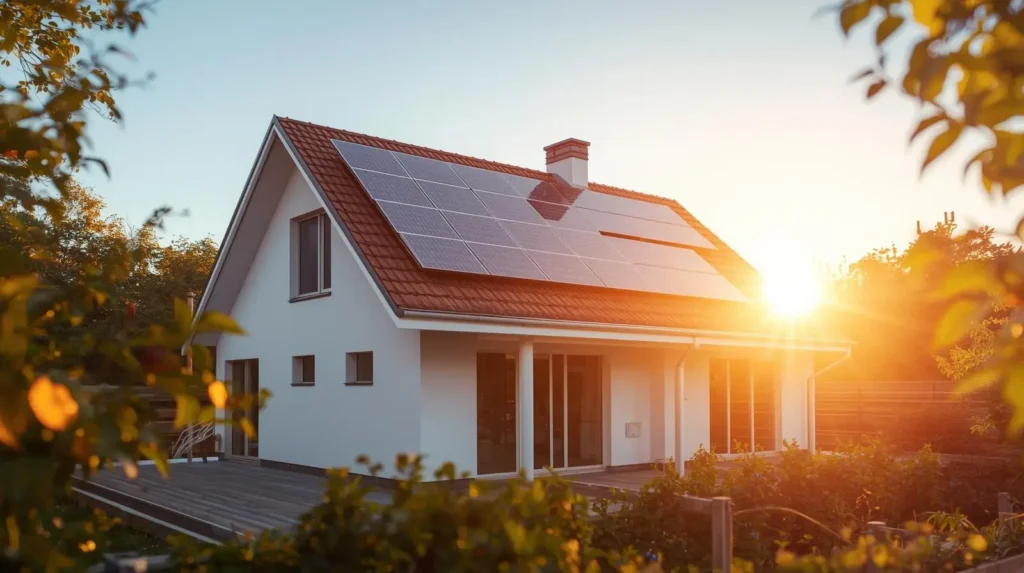
So now we are going to de-budget the true expense of installing solar energy into your home in component form.
1.Solar Panels Prices to your House.
The greatest portion of the total system cost is constituted by solar panels.
The Indian homes use solar panels in the following types:
- Monocrystalline (Higher efficiency, a little costly) panels.
- Polycrystalline panels (Inexpensive, a little lower efficiency)
India Solar Panel Price (2026 Estimates).
Panel Type Cost per Watt
For Monocrystalline ₹28 – ₹38
Polycrystalline ₹24 – ₹32
Example: Approximately 8-9 panels are needed to make a 3kW household solar panels system. Panel cost will be approx. ₹90,000 – ₹1,20,000 .Solar panels take up close to 45 to 50 percent of the system cost.
2. Home Solar Installation Cost of Solar Inverter.
The solar inverter takes DC power panels and transforms them into valuable AC power to your house.
Types of Inverters:
- String inverter
- Micro inverter
- Hybrid inverter (supports the battery)
Solar Inverter Price Range:
- Grid-tied inverter: ₹25,000 – ₹45,000
- Hybrid inverter: ₹45,000 – ₹90,000
An appropriate selection of an inverter is essential in effective solar power to use in the home.
3. Cost of Solar Energy Battery to Your Home.
The surplus energy of the sun is stored in batteries to be used during the night or power outages.
Common Battery Types:
- Lead-acid batteries (less expensive).
- Lithium-ion batteries (greater life and performance)
Battery Price in India:
- Lead-acid: ₹15,000 – ₹20,000 per battery
- Lithium-ion: ₹80,000 – ₹1,50,000
A common off-grid solar power house system can require 2-4 batteries making it much more expensive.
4. Cost of Structure, Wiring and BOS (Balance of system)
This includes:
- Mounting structure (alloy Aluminium-GI)
- DC & AC wiring
- Junction boxes
- Earthing and lightning arrestor.
Cost Range: ₹10,000 – ₹25,000 per kW. This element provides durability and security of household solar panels
5. Home Solar Installation and home Labor.
Professional installation is necessary to provide the best panel position and performance of the system.
Installation Cost:₹5,000 – ₹10,000 per kW
This includes:
- Panel mounting
- Electrical connections
- Testing & commissioning
An inappropriate installation will cut the efficiency by up to 15 so never compromise at this point.
Indian Cost of Solar Power to Household (kW) Total. Size of System Estimated Cost (No Battery)
- 1 kW ₹65,000 – ₹85,000
- 3 kW ₹1.8 – ₹2.4 Lakhs
- 5 kW ₹3.0 – ₹3.8 Lakhs
Depending on type, battery systems can push the cost to 60,000 to 2 Lakhs higher.
Solar energy subsidy by government to the Indian houses.
The government of India offers subsidies in the scheme of MNRE Rooftop Solar.
Subsidy Structure: Up to 40% for first 3 kW. One fifth of the extra capacity up to 10 kW.
Example: In a 3kW home solar installation, subsidy may help save cost by 60k to 78k.
Solar panels Maintenance Cost
Maintenance Cost of Solar Panels in Your House.
Among the greatest benefits of solar power as a home-driven power source, one can identify low maintenance.
Annual Maintenance Cost: ₹1,000 – ₹2,000 per year ,Includes panel cleaning 3-4 times a year mostly.
Solar energy for house Pros & Cons
Given below are the Pros & Cons on Solar energy for house.
Pros on Solar energy for house:
- Cuts down electrical costs by a significant margin.
- Insurance against tariff increases.
- Increases property value
- Green and environmentally friendly.
Cons on Solar energy for house:
- High upfront cost
- Cost of replacement battery (used)
- Needs rooftop space.
Solar power for house can be applied in house applications, although it requires an initial investment, it would be financially and environmentally advantageous to majority of Indian homes.
Solar Energy for house :Frequently Asked Questions (FAQs)
- What is the cost of solar power of a house in India?
The prices of a system that uses solar energy to power a house in India usually cost between ₹65,000 and 85,000 per kilowatt without the use of batteries to a grid-connected system. The average price of a typical 3kW home solar system is 1.8 to 2.4 lakhs and with government subsidy it can even be lowered.
- How many solar panels needed in a home?
The quantity of household solar panels relies on your household power than the electricity used. Averagely, 3–4 panels of solar panels are required to power a 1kW system. An average Indian family can need:
- 1kW for small homes
- 3kW for medium homes
- Large homes using AC are 5kW.
This guarantees that you have enough solar power in your house all year long.
- Will solar panels in house power up AC, fridge, and washing machine?
The answer is yes, you can easily operate ACs, refrigerators, washing machines, TVs, and fans via solar panels in your house. The size of the system should be well-calculated in terms of loads in order to provide sustainable solar energy to run the appliances.
- Does solar energy need batteries to be used in the house?
Grid connected systems do not require batteries. The net metering is utilized to deliver excess solar energy through grid-tied systems to power houses. Batteries are not necessary except in off-grid or hybrid systems where it is necessary to have backup power in times of outages.
- How long do solar panels last in the homes in India?
The lifetime of most household solar panels is 2530 years. Panels normally maintain 80-85% efficiency even after 25 years; hence solar energy to install in houses is a long-term and trustworthy investment.